
Will your shop benefit from 5-axis?
A 5-axis machine pays when your parts need multiple clampings today, carry tolerances across faces, or get declined because you cannot reach the geometry. It rarely pays for plate work, simple 2.5D production, or capacity problems that a pallet changer solves for less. Here is how to tell which side you are on.
The one number that decides it: clampings per part
Every clamping costs a fixture, a touch-off, queue time, and accuracy: each re-clamping re-references the part, and datum errors stack. A 5-axis machine typically reaches five faces in one clamping. So the audit is simple: take your ten most machined parts and write down the clampings each one needs today. Parts at three or more clampings are 5-axis candidates. Parts at one stay where they are.
Parts that benefit
- Parts with features on three or more faces that carry position tolerances to each other. One clamping removes the stack-up.
- Parts you decline today: compound angles, deep reach past shoulders, ports and undercuts. 5-axis access is what makes those quotable.
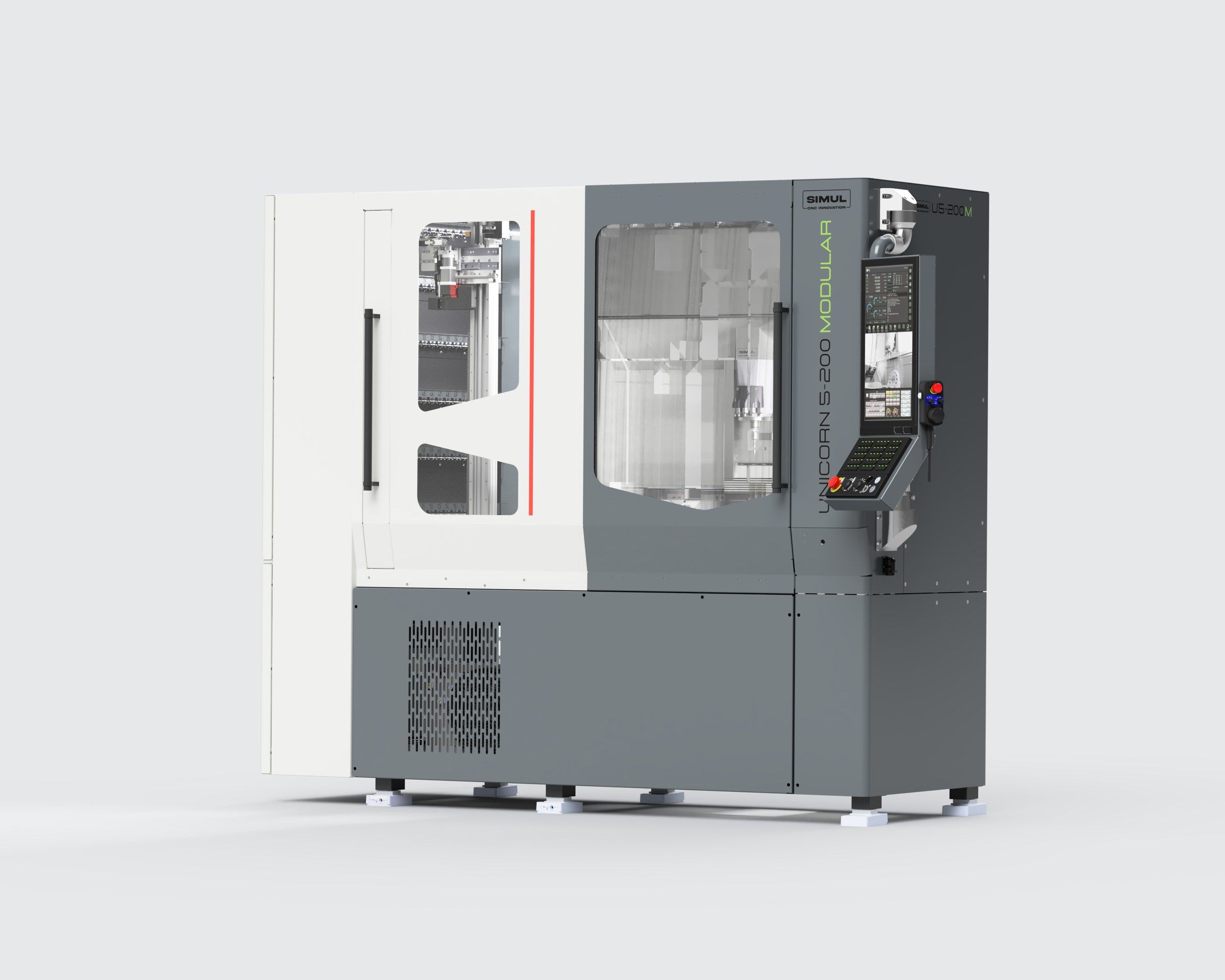
- Small complex parts in materials where a second clamping risks the part: thin walls, finished surfaces, exotic stock. The Unicorn 5-200 Modular, with its Ø225 × H233 mm work envelope, is designed for this class of work.
Parts that do not
- Plate and frame work that runs well on three axes.
- Long runs of simple parts where the bottleneck is spindle count. A pallet changer or a robot on the 3-axis machine you already own is usually the cheaper fix.
- Work where the stack-up from your current clampings stays well inside tolerance.
The second-order benefits, briefly
Fewer clampings mean fewer machines and fewer handling steps per part, which shortens lead times. One-clamping parts also automate more easily: a robot loads and unloads each part once, in one fixture. That is why 5-axis and automation compound each other, and why we designed the Unicorn 5-200 Modular around both.
Run the math on your own work
Ten parts, clampings counted, tolerances checked against faces. If the audit says three-plus clampings on work you win regularly, price a 5-axis machine into the quote and see what happens to the margin. Any builder's machine works for the exercise; ours publishes its price to make the math easy.