
Why mineral casting?
The base of the Unicorn 5-200 Modular is mineral casting (also called polymer concrete or epoxy granite) because a precision machine base is decided by vibration damping and thermal behavior: mineral casting damps vibration several times better than gray cast iron and responds far more slowly to temperature changes. The price is stiffness: mineral cast needs more cross-section to reach the same rigidity. Here are the numbers behind the trade.
What a base actually does
The base carries the machine's static and dynamic loads, decides how quickly cutting vibration dies out, and sets how the machine moves as shop temperature drifts. All three jobs affect surface finish, accuracy, and tool life, and each one depends on the material the base is made of.
The three candidates, in numbers
| Property | Gray cast iron | Mineral cast | Steel |
|---|---|---|---|
| Density | ~7.2 g/cm³ | ~2.3 g/cm³ | ~7.85 g/cm³ |
| Young's modulus | ~100 to 130 GPa | ~30 to 45 GPa | ~200 GPa |
| Vibration damping | good | best | poor |
| Thermal conductivity | ~40 to 70 W/m·K | ~3 W/m·K | ~50 W/m·K |
Damping is where the three separate. Steel is stiff but rings. In US Bureau of Mines tests, gray cast irons damped roughly 3 to 60 times better than as-rolled steels, depending on the grades compared, because their graphite flakes absorb vibration internally. Mineral cast damps roughly 4 to 10 times better again than cast iron, depending on the mix. Published figures vary widely with resin, aggregate, and test method (the mineral-cast advantage over cast iron is quoted anywhere from about 3x to 30x), so treat the multipliers as order-of-magnitude, but the ranking itself is not in dispute.
Thermal behavior compounds the advantage: mineral cast conducts heat poorly (about 3 W/m·K against 40 to 70 for gray iron), so the base responds slowly to drafts and sun patches in the hall.
What mineral casting costs you
Stiffness. With about a third of cast iron's Young's modulus, a mineral-cast base needs substantially more cross-section to hit the same rigidity target. The base takes up more volume than an equivalent iron base, though the material weighs about a third as much. You pay for damping and thermal stability with volume, and the machine's architecture has to be designed around that from the start.
Where cast iron still wins
Stiffness per volume. Complex structural parts with tight machined interfaces and bolted joints favor gray cast iron, which is why the Unicorn 5-200 Modular uses both: mineral casting for the base, gray cast iron for the large structural castings above it.
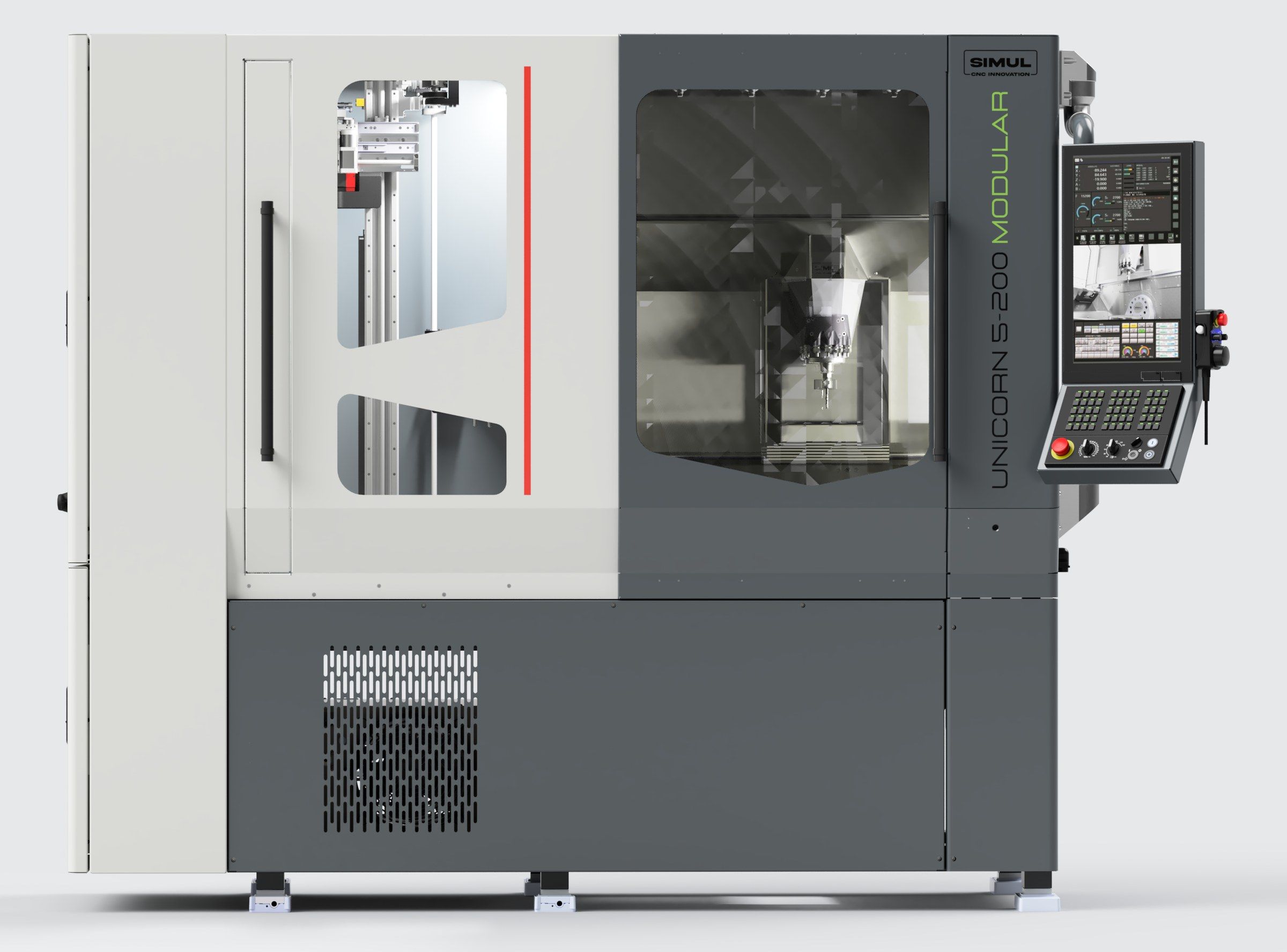
A mineral-cast base under a 60,000 rpm spindle
The Unicorn 5-200 Modular runs an HSK-E32 spindle to 60,000 rpm on small tools where surface finish is the product. Its base damps vibration several times better than gray cast iron and responds slowly to temperature changes in the hall. The datasheet lists the accuracy targets.